
Aïn Sefra, late September 1903. The last days of summer passed by monotonously. Under the oppression of a cloudless sky, Algiers slept. The streets, where passersby were rare, seemed wider, and swarms of blue flies buzzed in the brief shadows of the houses. The hills of Mustapha were veiled in fine dust, and the milky whiteness of the upper town faded. There, however, in the narrow alleys, life continued ardent, intoxicated with light and color, with displays of fruits and fabrics, and the pensive song of captive nightingales in front of the Moorish cafes. A heavy boredom weighed on Algiers, and I allowed myself to drift into a vague somnolence, without joy and without sorrow, and which, without desires as well, could have had the sweetness of annihilation. Suddenly, the battle of El Moungar occurred, and with it, the possibility of seeing the harsh regions of the south again: I was going to the South-Oranais, as a reporter... The dream of so many months was about to come true, and so abruptly!
The long train journey, across the entire west and southwest of Algeria, was delightful. In the initial joyful emotion of departure, I had a few hours of rest and reverie. There are times in life when nothing extraordinary happens, but which we never forget afterward, for they are of an indescribable sweetness. It was at Perrégaux where one must wait for the train to Arzew that descends southward. Perrégaux is just a Spanish town set amidst large green gardens, in the middle of a vast fertile plain. Yet, this very ordinary corner of the Algerian Tell (the Arabic term "tell" (height) refers in the Maghreb to the entire "useful" fringe of the reliefs near the coast, as opposed to the Sahara (desert) including the High Steppe Plains, editor's note) seemed cheerful, almost beautiful to me. The day was declining, clear, over the calm of the countryside. A high hill blocked the horizon, which gradually lit up. At the top, there was a small chapel of Sidi Abdelkader of Baghdad, which seemed all pink, among a few silhouettes of gray olive trees. There, in the dried grass, rough stones were hidden: the Muslim cemetery, a place of calm melancholy, without anything funereal… In the evening, I went to lie on a mat, in front of a Moorish café. Next door, above the carriage entrance of a Spanish inn, one could read in large clumsy letters: Defendido entrar gitanos, entry forbidden to gypsies. Opposite, a bare wall stood out against the pink opal of the sunset. Squatting on the ground, nomadic Arabs dreamed. In the warm air, familiar scents lingered, the scents of the Bedouin country, on summer evenings: smoke of thuja or juniper, smells of goat skins, tar, of bronzed flesh in moisture. And I savored the deep pleasure of the wandering life, the joy of being alone, unknown under the Muslim burnous (large sleeveless woolen cloak with a hood, editor's note) and turban, and of peacefully watching the day end in red glows over the simplicity of things, in this village where nothing held me, and which I was going to leave at nightfall.
Afterward, there were again long hours at the window of the carriage, through increasingly deserted and harsh lands, as the slow little train descended southward. Villages and towns passed in the moonlit night, swift, furtive, like visions. Around midnight, it was the sad Saïda, where so many human wrecks come to seek oblivion under the anonymous cloak of the Foreign Legion. Then, the tough climb of the high plateaus, on the winding track. The train's two engines were panting, wheezing like exhausted beasts. At the top, at the entrance of the vast bare plain, two twin marabouts seemed to stand guard. Stops in open countryside, for villages that were not visible or for distant douars (initially a group of tents, then a rural administrative district from 1863, editor's note): Aïn el Hadjar, Bourached, Tafaroua…
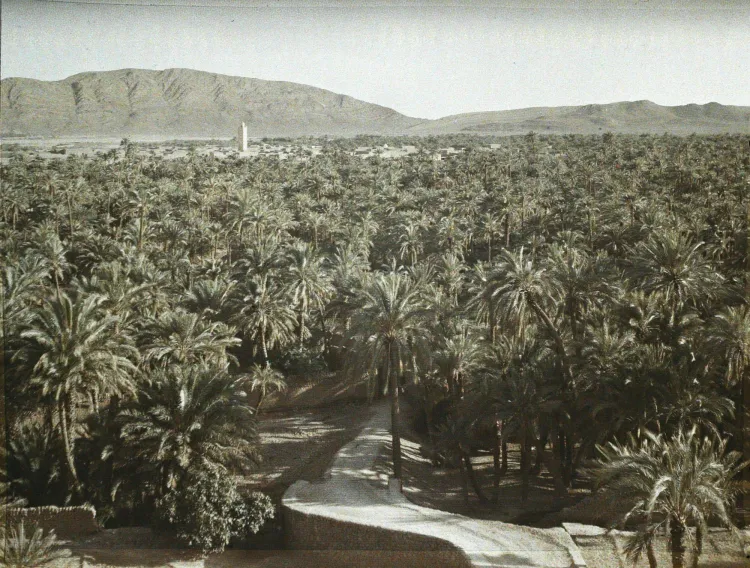
Finally, the day broke, in a green and red sky, over the pale dunes of the Kreider. And so indefinitely, it was always the grave monotony, the sadness, and also the great poignant charm of the southern plain, with its rare clumps of tough alfa and its creeping shrubs, gray on the sanguine soil. Chains of mountains fled into the distance, barely distinct, diaphanous. The sun rose, and we arrived facing the robust ridge of Djebel Antar advancing into the vagueness of the flat horizons. At the foot of this high blue wall, it was Mécheria, a few pink roofs, a few sparse yellowed trees, then, immediately after, nothing more, again the emptiness of the steppe where the iridescent lights of the morning played. The isolated stations had, from the Kreider, changed appearance: they were now tall little bastions flanked by gray watchtowers, closed with heavy iron doors... Finally, mountains emerged from the warm azure of the distances: Djebel Mektar, Mir el Djebel, the mountains of Sfissifa. Beyond, to the west, was Morocco. Large reddish dunes rose to assault the Mektar, like crashing waves. A bluish-green belt encircled the high brick buildings of the redoubt. To the right, a few Saharan houses in toub (rammed earth), huddled together, clumps of black fig trees, a few silhouettes of date palms, a few white marabouts. We finally stopped at Aïn Sefra, where I was only to pass through.
Share this story


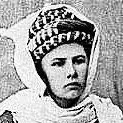
by Isabelle Eberhardt