
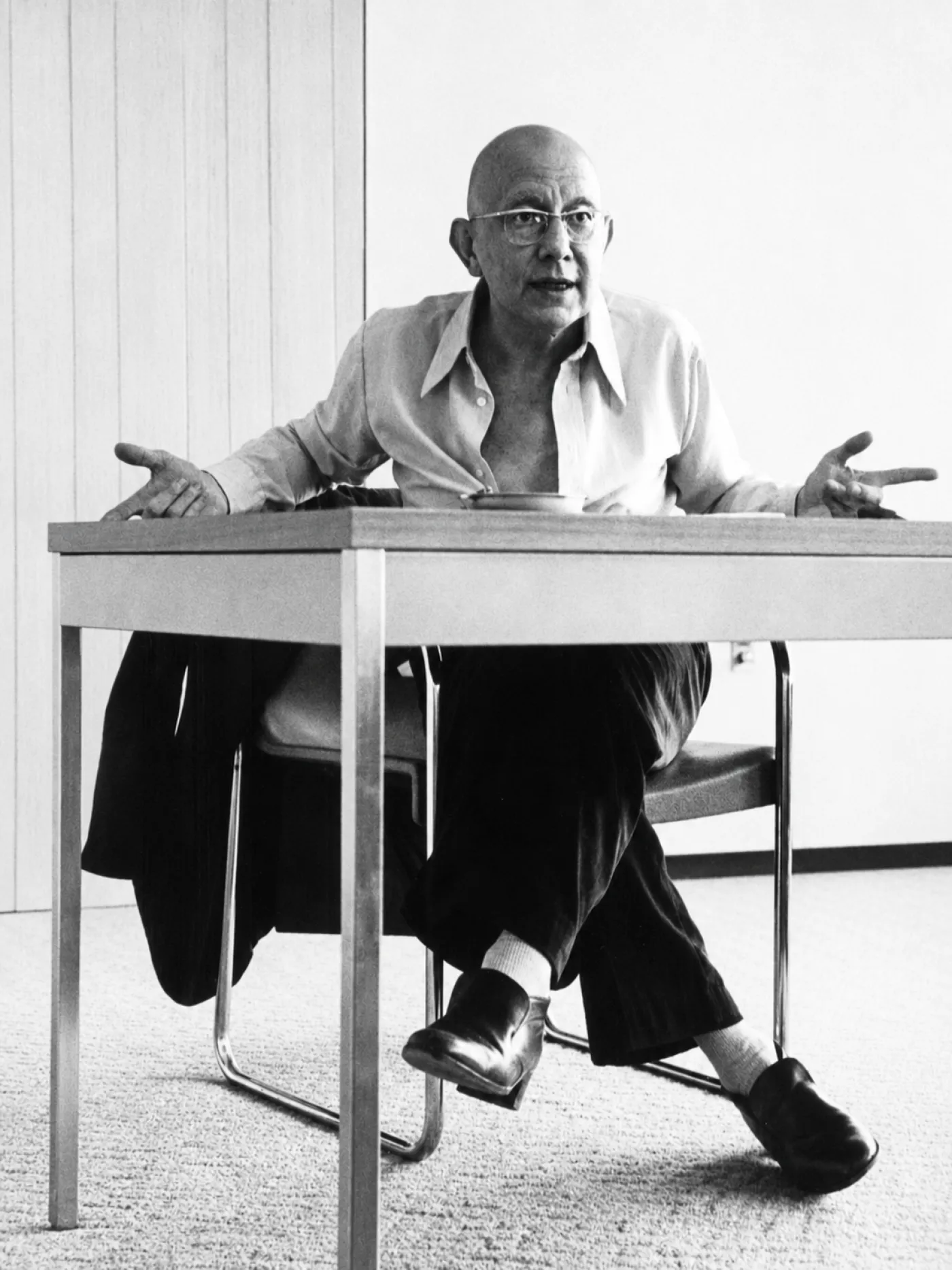
Considered one of the greatest thinkers of the second half of the 20th century, alongside Paul Ricœur, Cornelius Castoriadis leaves behind a dense, vertiginous body of work, always enlightening in the way it questions autonomy in the face of the heteronomy of political and social institutions.
His French governess — who was then preparing a dual thesis in philosophy — had a decisive influence on him and contributed to his intellectual awakening. Very early on, he became involved: well before the Nazi occupation, in 1941, he joined the Greek Trotskyists. With a few comrades, he founded a small magazine that, in addition to resisting the occupier, criticized the Communist Party's line, deemed chauvinistic and bureaucratic. When the Germans left Greece in 1944 and the British took over, Castoriadis was arrested by the right-wing forces. He narrowly escaped. Hidden for several months in a cellar, he awaited the boat that would exfiltrate him and other students to Italy, before joining Paris.
Arriving in France in 1945, at the age of 23, he lived frugally before joining the OECD as an economist in 1948, where he climbed the ranks to hold high responsibilities. He left the institution in 1970 to devote himself fully to psychoanalysis — a discipline in which he would lead a second intellectual life — while becoming, from 1980, director of studies at the EHESS, where he would give philosophy seminars for fifteen years.
His arrival in Paris also marked the beginning of intense political engagement. He first joined the French section of the Fourth International (Trotskyist) but quickly broke away from this group, notably due to disagreements over the defense of the USSR and Tito's Yugoslavia. With Claude Lefort, he founded the group Socialisme ou Barbarie (SouB) in 1949. While Sartre and a large part of the French intellectuals rallied behind Soviet communism, SouB denounced the totalitarian nature of the regime very early on. The group never had more than twenty active members, and its magazine never exceeded two hundred copies, but its influence was profound on leftist political thought until its dissolution — ironically — in 1967, a year before May 68.
Born in 1922 in Constantinople, Castoriadis arrived in Greece a few months later. His father, an Orthodox Christian but deeply Voltairean, passed on his love of France and republican values. This father, a womanizer, transmitted syphilis to his wife; treated himself, he neglected her, and she died in 1938. Cornelius, aged sixteen, then developed total alopecia, which would mark him permanently.
A man of rupture, Castoriadis also distanced himself from the Lacanian movement, which was dominant in French psychoanalysis in the 1970s. It was also the time when the "new philosophers," led by Bernard-Henri Lévy, tried to position themselves as revealers of totalitarianism — after having praised Mao a few years earlier. Their media success, notably with the publication in 1977 of La Barbarie à visage humain, temporarily buried the visibility of a thought like Castoriadis's, which was much more demanding.
The paperback publication of the biography dedicated to him by François Dosse (Castoriadis, une vie, La Découverte) allows for the rediscovery of a major but too little-read intellectual, as was long the case with Paul Ricœur, to whom Dosse also dedicated a biography. Ricœur and Castoriadis were contemporaries, divergent on many points, but united by the same questioning of "responsibility" and by a resolutely multidisciplinary method. Ricœur, a Protestant, worked in a theological tradition that was not that of Castoriadis, who was Marxist then de-Marxized. But their correspondences testify to mutual esteem and deep convergences.
In the years 1964-1965, Castoriadis made a decisive turn: the radical imaginary became for him the keystone of human creation, rendering deterministic theories obsolete. The Imaginary Institution of Society (1975), his first major book, situated at the crossroads of philosophy, politics, and psychoanalysis, is a fierce critique of "inherited thought," particularly Marxism. For those hesitant to delve into the six volumes of Crossroads in the Labyrinth, A Society Adrift: Interviews and Debates (1974-1997) offers a more direct entry into his thought and his way of illuminating the issues of the 21st century — where autonomy is more threatened than ever.
Share this story


by Pascal Vandenberghe