

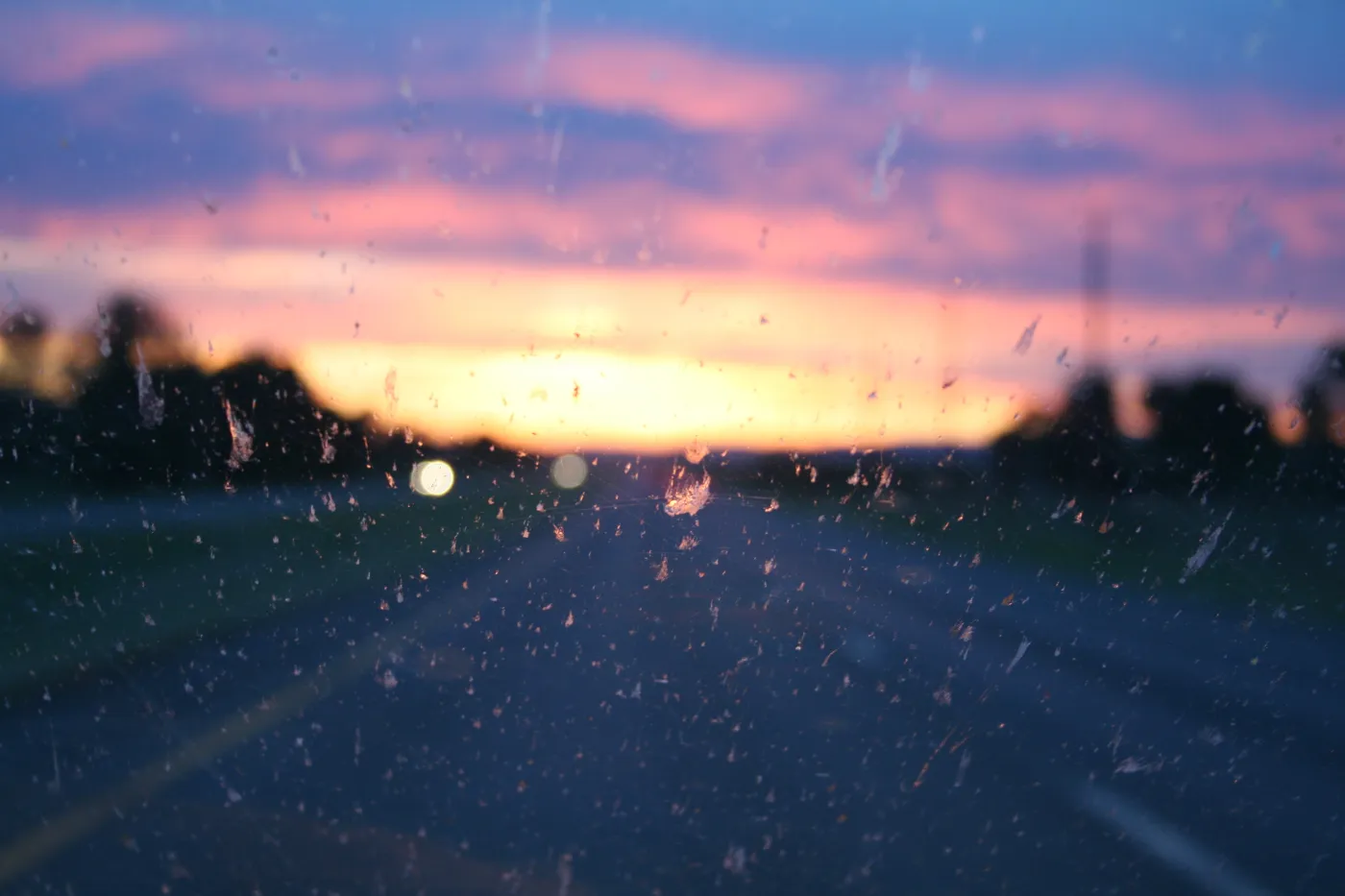
Entomologists call it "the windshield phenomenon." "You'll see that it resonates with everyone. We all remember the time when insects would splatter on the windshield," says Wolfgang Wägele, director of the Leibniz Institute for Animal Biodiversity Research in Bonn. Today, motorists spend less time scraping and scrubbing. "I'm not an emotional person," admits Scott Black, executive director of the Xerces Society for Invertebrate Conservation, based in Portland, Oregon. "But it affects me not to see all that mess on the windshield anymore."
Some will say that today's more aerodynamic cars are less deadly for insects. But when he was a teenager in Nebraska, Scott Black drove a 1969 Ford Mustang Mach 1, a sleek model he was proud of. "And I kept washing my car. It was always covered in insects." German entomologist Martin Sorg recounts an opposite experience: "I drive a Land Rover with the aerodynamics of a refrigerator, and yet it's never dirty."
These observations are not scientific, but there is little reliable data on the fate of many important species. Researchers have noted an alarming decline in populations of honeybees, monarchs, and fireflies; but few have focused on moths, hoverflies, beetles, and countless other insects that fly during the warm months. "We are very good at ignoring uncharismatic species," acknowledges Joe Nocera, an ecologist at the University of New Brunswick.
Among the few existing surveys, many come from amateur naturalists. This is how an exceptional series of data collected since the 1980s by the Krefeld Entomological Society emerged, a group of amateurs tracking insect population trends in a hundred nature reserves in Western Europe. In 2013, they detected something alarming: at one of their oldest capture sites, established in 1989, the total mass of catches had dropped by nearly 80%. They first thought it was a bad year and reinstalled the traps in 2014. The quantities collected were just as low. By directly comparing samples accumulated over three decades, they discovered a dramatic decline in numbers at more than a dozen sites.
Such losses affect the food chain. "For an insectivorous bird living in the area, it means that four-fifths of its food has disappeared in twenty-five years, which is staggering," observes Dave Goulson, an ecologist at the University of Sussex. He analyzes and publishes some of these data. "We'd like it not to be representative, to be an artifact."
No one knows if these observations reflect a global trend, but they offer a unique insight into the state of little-studied species. In Germany, the red list of threatened insects seems not very alarming, explains Martin Sorg, head of the Krefeld collection: few species are declared extinct because a few individuals are still found here and there. This masks the fact that many have disappeared from vast regions where they were once common. In the Krefeld region, more than half of the twenty bumblebee species recorded at the beginning of the 20th century have disappeared.
The Krefeld Entomological Society has been observing, studying, and collecting insects since 1905. It is headquartered in a former school in the city center, where classrooms house more than a million pinned specimens, identified and stored in boxes, as well as tens of millions more preserved in alcohol. The studied nature reserves are not pristine nature but "semi-natural" habitats: former hay meadows rich in wildflowers, birds, small mammals — and insects, of course.
It was almost by chance that the society began collecting long-term data. In the late 1970s and early 1980s, local authorities asked the group to assess the effects of different reserve management strategies on insect diversity. Each site was monitored only every two or three years, but with the same traps installed in the same places, to ensure reliable comparisons. The traps are "Malaise" models, developed in the 1930s: black tulle tents with a white roof equipped with a collecting container whose vapors intoxicate the insects before making them fall into a jar of alcohol.
Each trap captures only a few grams of insects per day, equivalent to a shrew's ration — a negligible impact. Members have preserved all samples, aware since the 1980s of their value as snapshots of a changing world. Some are still not classified: a meticulous job with tweezers and a microscope.
The data presented publicly — notably during a hearing at the Bundestag — is alarming. The global biomass is declining, as are many groups previously neglected. Hoverflies, important pollinators often mistaken for bees, are experiencing a particularly rapid decline: in one reserve, 17,291 hoverflies belonging to 143 species were captured in 1989; in 2014, in the same place, only 2,737 individuals of 104 species.
Since 2013, the group has been installing more traps each year and collaborating with several universities to search for correlations with weather, vegetation, and other factors. No obvious cause emerges. Even in reserves where plants are thriving, the number of insects is decreasing.
Land use changes around the reserves likely play a role. "If we turn all semi-natural habitats into wheat or corn fields, there will be practically no life in these fields," notes Dave Goulson. Agricultural intensification reduces habitats to isolated islands. The massive use of fertilizers favors grass over wildflowers. Artificial lighting disrupts nocturnal insects.
Neonicotinoids are also implicated. Used since the 1980s, they spread into the environment. They were thought to be harmless at authorized doses, but they alter insect navigation and communication. In 2017, a study showed that exposure to just 1 nanogram of a neonicotinoid halved the mating rate of a parasitoid wasp and reduced its ability to find a host.
However, it is impossible to establish a direct link: "We do not have data on the quantities of insecticides in the reserves," Sorg reminds. Researchers struggle even to know which pesticides are used in neighboring fields.
Share this story



by Gretchen Vogel